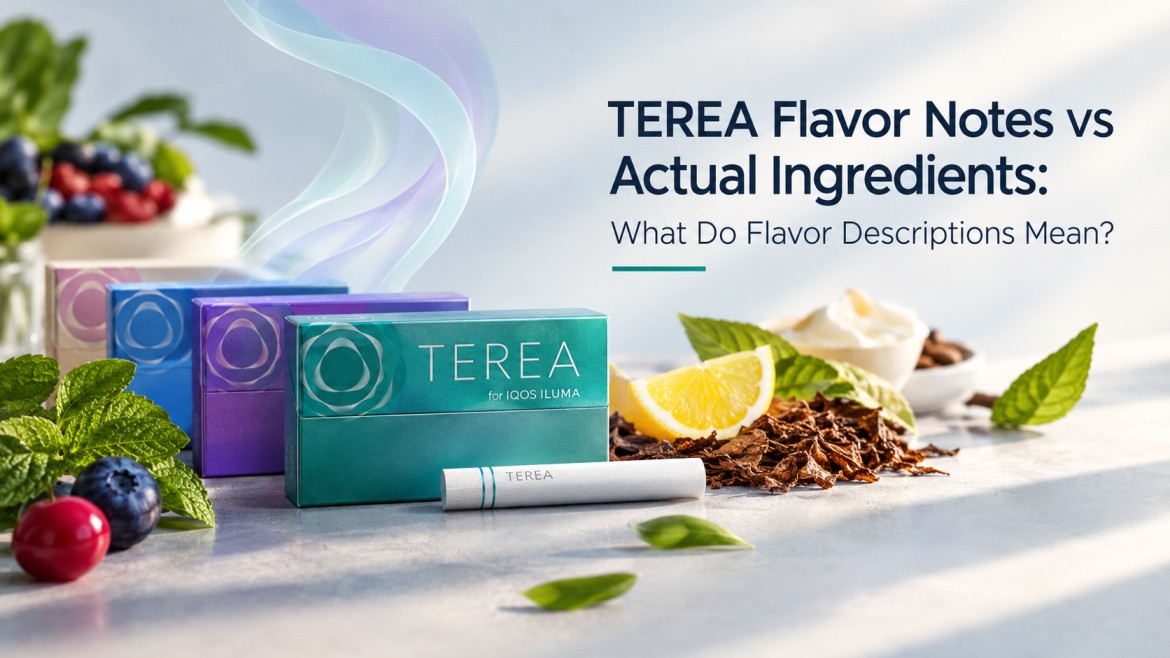
Pick up any pack of TEREA sticks and you will find words like “woody,” “smooth,” “fresh,” or “cooling” on the packaging or product listing. These terms appear across every edition available in the UAE, from TEREA Japan to TEREA Kazakhstan, and they raise a fair question among new users: does “woody” mean there is actual wood inside the stick? Does “fruity” confirm a particular fruit was added? In almost every case, the answer is no. A flavor note is a sensory descriptor, not an ingredient declaration, and understanding that difference will change how confidently you shop.
This article is written for UAE buyers who compare TEREA editions online before ordering. When physical sampling is not always possible, the ability to read and interpret flavor language becomes a genuinely practical skill. By the end of this guide, you will know how to decode a TEREA flavor description, compare profiles across different editions, and stop misreading sensory language as formulation information.
What Is a TEREA Flavor Note?
A flavor note is a descriptive term used to communicate what a product may taste or feel like during use. It is sensory shorthand, giving buyers a reference point before trying something new. A coffee brand might describe its blend as “nutty with a caramel finish” without including actual nuts or caramel. TEREA product descriptions work on the same principle. Flavor notes can describe taste, aroma, physical sensation, or the impression a product leaves at the end of a session.
Flavor Note vs Flavor Profile
A flavor note is one recognizable sensory characteristic. A flavor profile combines several notes to define the product as a whole. A TEREA Kazakhstan variant might carry a tobacco forward profile with woody and warm notes. “Woody” communicates one aspect of what you may perceive. The full profile gives a richer and more accurate picture than any single word can on its own.
What Actual Ingredients Means and Why It Differs From a Description
The word “ingredient” refers to a substance that is physically present in a product’s formulation. An ingredient list is a factual statement about what went into making something. A flavor description is sensory language written to communicate an experience. In regulated product categories, these two things are intentionally kept separate because they serve different purposes entirely.
A TEREA product listing that describes a profile as “fresh and cooling” is not making a formulation claim. When you genuinely need to know what a specific product contains, the correct source is always official manufacturer documentation or the physical packaging, not a marketing description. Understanding how TEREA products differ from HEETS gives useful background context for why this distinction matters in practice.
Why Every Flavor Word Is Not an Ingredient
“Woody” does not automatically mean wood is a component of the stick. “Fresh” does not automatically identify a specific mint extract. “Warm” does not necessarily point to cinnamon or any named spice. “Fruity” does not necessarily identify one particular fruit as an ingredient. A tasting note tells you how a flavor may be perceived. An ingredient list tells you what is physically included. These are two completely different categories of information.
Common TEREA Flavor Terms Explained
Tobacco Forward and Rich
When a product is described as tobacco forward, tobacco character is the dominant impression throughout the session. Other notes exist in the background rather than competing for attention. Rich communicates depth and fullness. It suggests that the overall character feels substantial rather than thin or light. Many TEREA Switzerland variants carry this kind of profile, where the tobacco character remains central and the overall experience feels complete and developed.
Smooth, Woody and Warm
Smooth means the overall experience is perceived as less sharp or harsh than alternatives. It is a holistic description of the whole session, not an indicator of any one component. Woody is an aroma and taste association meant to evoke a dry, earthy, or warm sensory impression. Warm, similarly, communicates a deeper or fuller sensory character. Neither woody nor warm provides evidence that a specific ingredient is present. Comparing TEREA Amber and Bronze shows how these terms work together to differentiate two closely related profiles.
Fresh and Cooling
Fresh communicates a clean, open, non heavy overall impression. Cooling is worth distinguishing from fresh because cooling is primarily a physical sensation rather than a flavor in the strict sense. These two terms are related but not identical. TEREA Turquoise Kazakhstan is a good example of a variant where both cooling sensation and fresh character are present and work together in the overall experience.
Fruity and Citrus
Fruity is a broad category that communicates the flavor direction leans toward fruit oriented territory without identifying which fruit is responsible. When a specific fruit name appears in the description, that is more precise information. “Fruity” on its own is a category indicator. Citrus locates the product within a recognizable flavor family: bright, slightly sharp, and aromatic. A general citrus note tells you the direction. A named citrus gives you more specificity. Checking the flavor category page helps you browse products grouped by flavor character when a specific profile direction is what you are looking for.
Do TEREA Flavor Notes Mean the Product Contains Those Ingredients?
Not necessarily. This is the clearest and most direct answer, and it deserves to be stated plainly. Flavor notes are sensory descriptors written to communicate what a product may feel like to use. Ingredients are formulation details. A TEREA description using the word “citrus” is not declaring that citrus extract was added to the formulation. It is describing a sensory impression. A product described as “floral” is not declaring that any flower derived botanical is present. The only time a descriptive term should be interpreted as ingredient information is when official product documentation specifically and explicitly identifies it as such.
Flavor Name, Description, and Ingredient: How They Differ
| Element | What It Tells You | Example |
|---|---|---|
| Product Name | Identifies the edition | TEREA Amber, TEREA Silver |
| Flavor Note | Describes one sensory characteristic | Woody, Smooth, Fresh |
| Flavor Profile | Combines multiple notes into an overall picture | Rich tobacco with warm, woody notes |
| Ingredient | Identifies something actually used in the formulation | Only where officially and specifically stated |
The product name gives you an identity. The flavor note gives you a single sensory reference. The profile gives you a broader map. Ingredient information, where provided, gives you formulation facts. These four categories should never be collapsed into one another when making a purchasing decision.
How to Compare TEREA Flavors Using Flavor Notes
Rather than reacting to one word, use a structured approach to compare editions against each other. Look at four dimensions: tobacco intensity (light, balanced, or full), flavor direction (tobacco, fruity, cooling, or aromatic), secondary character (woody, warm, floral, or citrus), and finish (clean, cooling, smooth, or lingering). Mapping each product across these four dimensions allows you to compare editions from different origins in a structured way.
For example, TEREA Amber Switzerland and TEREA Amber Kazakhstan share a name but may carry slightly different profiles. Reading the full description across all four dimensions reveals where they differ, which is far more useful than comparing product names alone. The same principle applies when browsing TEREA Indonesia editions, where flavor direction and secondary character often differ significantly between variants within the same origin range.
Why Flavor Perception Differs Between Users
Flavor descriptions are reference points, not guarantees. The same IQOS TEREA product can genuinely be perceived differently by different users, and this reflects the nature of sensory perception rather than any inaccuracy in the description. Individual taste sensitivity varies considerably. Longtime smokers often perceive tobacco character differently from new users. Smell perception, which plays a major role in overall flavor experience, differs between people. What was eaten or drunk before a session can also influence what is tasted during it.
When a description says a product has a “woody” character, that is a reasonable reference for most users. One person may find it prominent, another may find it subtle, and a third may barely register it. All three responses can accurately reflect individual perception. This is also worth keeping in mind when reading user reviews: other people’s experiences are useful data points but not definitive guides to your own. This article on why the same TEREA flavor tastes different on different days covers this topic in more detail.
Common Mistakes When Reading TEREA Flavor Descriptions
Assuming every flavor word is an ingredient
Sensory language and ingredient language operate on entirely different principles, and conflating them leads to incorrect conclusions about what you are buying.
Choosing only by the product name
Names like TEREA Silver Kazakhstan or TEREA Bronze Switzerland are identifier labels, not complete sensory descriptions. Always read the full profile.
Treating “smooth” as a strength rating
Smoothness and tobacco intensity are independent dimensions. A smooth product can still deliver a full, pronounced tobacco character.
Assuming “fresh” always means mint
Freshness is broader than mint. A product can deliver a fresh impression through different sensory mechanisms entirely.
Expecting everyone to taste the same notes
Genuine individual variation in perception means a description lands differently for different people. That variation is normal, not a sign the description was inaccurate.
Quick Reference: TEREA Flavor Language
| Flavor Term | Usually Communicates |
|---|---|
| Smooth | Softer overall sensation, less sharp or harsh |
| Rich | Fuller, deeper character with prominent presence |
| Woody | Dry, earthy aromatic association |
| Warm | Deeper sensory character, often richer or fuller |
| Fresh | Clean, open, non heavy overall perception |
| Cooling | Physical cooling sensation during and after the session |
| Fruity | Fruit oriented flavor direction, lighter and often sweeter |
| Citrus | Bright, sharp, citrus family aromatic profile |
| Floral | Delicate, flower like aromatic quality |
| Tobacco Forward | Tobacco is the dominant, primary sensory character |
The terms above are descriptive interpretations based on sensory language. They are not ingredient declarations. For formulation specific information, always refer to official product documentation.
FAQs
What is the difference between a TEREA flavor note and an ingredient?
A flavor note is a sensory description of what a product may taste, smell, or feel like. An ingredient is a substance physically present in the formulation. The two are separate categories of information and should never be treated as the same thing.
Does “woody” mean TEREA contains wood?
No. Woody is a sensory descriptor communicating a dry, earthy, or warm aromatic association. It describes how the product may be perceived, not what physical material is present in the formulation.
Does “fresh” always mean mint?
Not necessarily. Fresh is a broad sensory description communicating a clean, open, non heavy impression. Mint can produce freshness, but freshness is not exclusive to mint and the word alone does not confirm mint as an ingredient.
Can flavor notes tell me how strong a TEREA stick is?
Not directly. Flavor character and perceived strength are different dimensions. A product described as smooth is not necessarily low in intensity. Check the TEREA strength chart for a clearer picture of intensity across variants.
How should I choose TEREA based on flavor descriptions?
Look at the complete profile rather than reacting to one word. Use the four dimension framework of tobacco intensity, flavor direction, secondary character, and finish. Browsing by category such as TEREA Uzbekistan or Pearl Flavors can also help you narrow options before comparing individual profiles.
Where can I find the actual product information?
For formulation specific details, rely on the official product packaging or manufacturer documentation. Flavor notes are sensory communication tools, not substitutes for factual ingredient information when specific knowledge is required.
Where to Buy TEREA Sticks in the UAE?
TEREA Dubai delivers authentic TEREA sticks across all emirates. Orders within Dubai, Ajman and Sharjah are delivered within 1 hour, and UAE wide delivery is completed within 12 hours. Free delivery applies to all orders over 400 AED. The full range across all origins and editions is available in one place, making it easy to compare and order exactly the profile you are looking for without visiting multiple stores.
Conclusion
Flavor notes describe an experience. Ingredients describe a formulation. When you read “woody,” “fresh,” “cooling,” or “fruity” in a TEREA product description, you are reading sensory language designed to help you anticipate what using that product will feel like. You are not reading an ingredient list, and treating the two as the same thing leads to confusion that is entirely avoidable once the distinction is clear.
For UAE buyers comparing products from TEREA Italy, TEREA Switzerland, TEREA Kazakhstan, and other origins simultaneously, this understanding has direct practical value. Use flavor descriptions to narrow your preferences and identify products worth trying. Compare profiles using the four dimension framework. When specific ingredient information matters for any health or personal reason, always go to the official product documentation. A flavor description and an ingredient declaration are two different things entirely, and knowing that makes you a more confident buyer every time you shop.